
A Guide to Diamond Cut
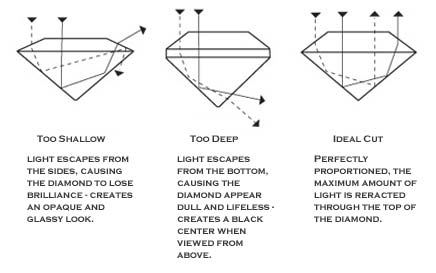
Diamond cut has the greatest influence on how a diamond looks in everyday light. At Joseph Jewelry, we consider cut the most important of the Four Cs because it determines how effectively a diamond returns light to the eye. A diamond with strong cut quality will usually appear brighter, more lively, and more visually impressive than a larger diamond with weaker proportions.
Why Cut Matters Most
Cut affects brightness, fire, and contrast. These are the visual qualities that most people notice first when they look at a diamond. Even if a diamond has strong clarity and color grades, it can still appear dull if the cut is not well executed.
At Joseph Jewelry, we recommend prioritizing cut because it has the strongest effect on visible performance. In many cases, a smaller diamond with better cut quality will appear more beautiful than a larger diamond with poorer light return.
How Cut Affects Light Performance
A diamond's facets must be arranged at angles that allow light to enter, reflect internally, and return back through the top of the stone. When those proportions are well balanced, the diamond appears bright and lively. When they are not, light escapes through the sides or bottom, reducing brilliance.
This is why cut is not only about shape or outline. It is about how the entire diamond is proportioned and finished to manage light effectively.
From Rough Diamond to Finished Stone
A rough diamond does not naturally display the visual performance associated with a finished gem. That performance depends on how the stone is planned, cut, and polished. The cutter must decide how to balance proportions, symmetry, and retained weight during the cutting process.
At Joseph Jewelry, we view this stage as one of the most important parts of a diamond's development. A finished diamond should not simply preserve as much weight as possible. It should be cut in a way that gives the stone strong visual life.
Proportions, Polish, and Symmetry
Cut quality is influenced by more than one characteristic. Proportions affect how light moves through the stone. Polish affects the quality of the facet surfaces. Symmetry affects how consistently the facets align and interact with light.
These factors work together. A diamond with balanced proportions, strong polish, and well-executed symmetry will usually perform better than one that falls short in any of these areas.
What Triple Excellent Means
The term Triple Excellent is commonly used for round brilliant diamonds graded Excellent in cut, polish, and symmetry by GIA. This designation can be a useful starting point because it indicates a high standard in the three categories most closely tied to finishing and light performance.
Even so, not every Triple Excellent diamond looks exactly the same. At Joseph Jewelry, we recommend using the grade as part of the evaluation, not as the only factor. The actual visual performance of the individual diamond still matters.
Choosing a Diamond with Strong Cut Quality
A well-cut diamond should look bright across the face of the stone, show balanced contrast, and remain lively under normal lighting conditions. We recommend comparing diamonds carefully and giving cut the strongest weight in the decision. This often leads to a better result than focusing too heavily on carat weight alone.
At Joseph Jewelry, our approach is to evaluate cut in practical visual terms so you can choose a diamond that performs well, looks balanced, and remains satisfying over time.